Introducing Wimym: where is your mind?
Working with agents never tells you to stop. Wimym reads your Claude Code transcripts on your own machine and shows, against your own usual, how your weeks are going for your health and your work.
By Alexandre Collet
Working through agents is a new kind of work. You say what you want, answer questions, choose, correct, approve and decide when something is finished, often in several sessions at once and across several projects, while the agents do the making.
The feedback loop is new too. You send a message, and a few minutes later something exists that didn't before. The result comes fast, is often impressive and is hard to predict. There is always another session waiting with something to look at, and since the agent doesn't get tired, the work never gives you a reason to stop. Rewards that are fast, variable and available at any hour, with no natural end, are typical of the loops that make behaviour compulsive.
Someone on an ambitious project can spend fourteen hours a day like this, every day, for months. The days are full and the output is real, but at the end of the week it's hard to say what was decided, what was dropped and what was only postponed. Fatigue shows up as later nights, shorter replies & more irritation, and it gets noticed late. You can see that you're busier. You have no way to see whether you're getting better at the work, or at living with it. We built Wimym, short for Where is your mind, for people who work with agents on ambitious projects and want to look after their mind while they do it.

A Wimym postcard: each string is a session, rung as its messages pass, and the aurora is the weight each project carries. Robin is a made-up person, used for the demo.
The record
This work gets written down as it happens, which is unusual. Claude Code keeps every message with the time it was sent and what followed: what the agent read, ran & changed, how long it took, what shipped and what was stopped. Your messages show what you ask for, what you decide and what you hand over, and how your tone changes through the day. Git shows what landed and what was still in place a month later. The agents' memory contains their notes about you, rule by rule, and you probably keep no equivalent notes about yourself 😄.
Athletes get better by watching game film with a coach, who picks the moments that mattered, names what they have in common, agrees with the athlete on what to change and checks later whether it changed. Most knowledge workers never had this, partly because their work left nothing to watch. Agent work does leave a record, but transcripts are too long to reread and too scattered to compare, and the tools that write them only read them back to resume a session. Claude Code also deletes old transcripts after a while.
We think an agent can now do the part that used to take a coach's time: reading weeks of messages and finding the moments worth a look. Deciding what a pattern means and what to change stays with you.
What Wimym does
Wimym reads your Claude Code transcripts, your prompt history and your git history on your own computer. It shows how your weeks are going for your health & your work, compared with your own usual.
- This week. The front page starts with a loom woven from your messages in the order you sent them, with a column per project and a string per session. Below it, the week is drawn as a spiral, one turn a day, against your usual day and the hour you meant to stop.
- Vital signs. Each sign covers twelve weeks, with your own range drawn as a band. They include days in a row, active hours, nights & days off, your longest stretch on one project and how often you switch, minutes past your stopping hour, go-aheads sent before you could have read the reply, strain in your messages, and projects that went quiet with nothing landed. Signs that have been outside your range for two weeks running come first, with one plain sentence each.
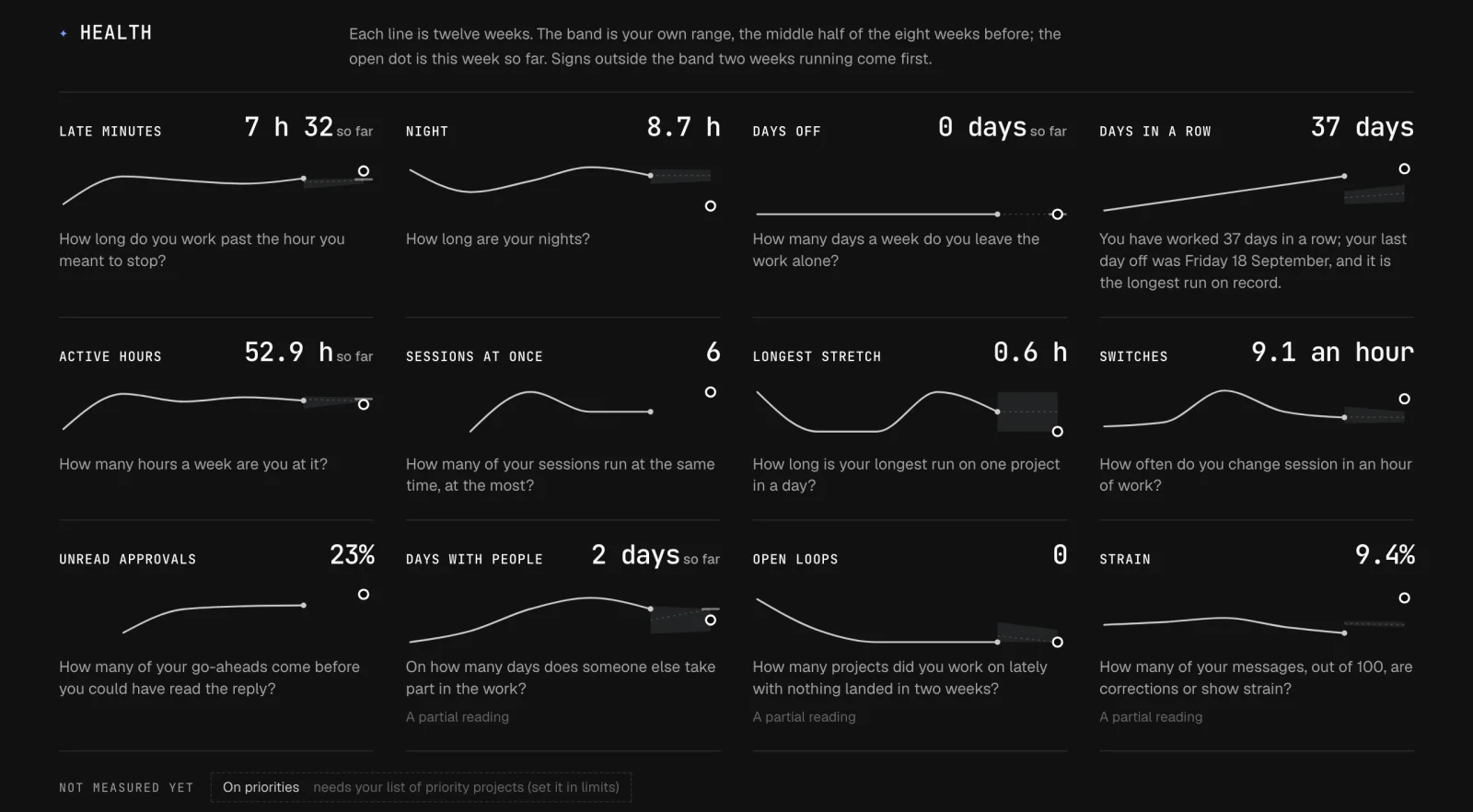
Robin's vital signs in the demo. Each line covers twelve weeks, the grey band is Robin's usual range, and the open dot is this week so far.
- The weekly retro. This is the main part. Once a week, a Claude session that has read the week brings a few moments worth looking at, each with the messages behind it, and asks what you see. You talk it through and come away with one or two practices to try, or none if nothing needs changing. We made it a conversation because most people find it easier to reflect by talking than by looking at a dashboard.

The week page that the retro starts from: an account of Robin's week and the signs outside Robin's usual range. The moments to talk through come further down the page.
- Practices & limits. A practice is something you decide to do differently, written down with the sign that would show whether it held. Some are for you (stop at a set hour, say what done looks like in the first message). Others are cheaper to hand to the agents as a rule, and nothing is added to their instructions without your yes. You can set a stopping hour, days off a week or a maximum number of sessions at once, and an optional hook tells you in Claude Code when you cross one. The next retro starts with the practices in progress, and you decide whether to keep, change or drop each one.
- The film library. Every day is shown as a score of its sessions. Every message you sent can be filtered by what it asks for, its tone or its project, and opened in full with Claude's reply and the command to resume the session. Wimym keeps what it has read after Claude Code deletes a transcript, so your history keeps growing.
How it reads you
- Your own past is the yardstick. Every measure is read against your previous weeks.
- You draw the conclusions. Wimym brings a pattern with its evidence, as a question, and you judge whether it matters. You also say what "better" means for you: fewer hours, deeper focus, finishing what you start, or something else.
- Every number has its messages. Each sentence, share or curve links to the messages & commits behind it. Readings made by a model (tone, intent) are marked as such, and their accuracy is checked before a measure uses them.
- Signs, for you to read. Wimym shows signs of compulsion, fatigue or strain in how you work, next to your own account of how you are, which comes first.
Private by design
Wimym runs on your own computer. It reads your transcripts where they are and serves its page to your machine only. When you run the labeller or ask a question through the skills, the text goes to Claude through your own login, the same Claude that wrote the replies in the first place. Your record stays yours, and Wimym is made for the person it describes.
When you want to show it to someone, a share switch hides every word, project name and person's name, so you can share the page or post a screenshot safely.
Try it
Wimym is young, and we built it for one person first. If you use Claude Code most days, you'll have enough history for it to be useful.
You can go through the whole app on Robin's record in the demo without installing anything. To run it on your own record (macOS, or Windows 10 or 11), paste this into Claude Code:
Set up Wimym on this computer for me. Read the guide with
curl -fsSL https://wimym.matricetechnologies.com/setup.mdand follow it step by step: say what each step does, and ask me before anything that changes my computer.
Claude checks your computer, asks all its questions at once, then does what you chose. The code is in a private repository for now, so you'll need an invitation, and Claude tells you which GitHub account to send us. Everything else is on wimym.matricetechnologies.com. The method also works with Claude Code alone: a regular retro over your own record, ending in practices that you check against the following weeks. Wimym makes that easier and keeps your full history.