My take on Planning with Agents
Stop planning the steps and plan the edges: a shared picture of the goal, acceptance written before the work, and a view of whether the agents are converging.
By Alexandre Collet
A friend of mine, Drew Winget, shared this post from Maggie Appleton with me a few days ago. I encourage you to read the post too :) In any case, here is my take on the article:
I think we can go further: stop planning the steps, and only plan the edges.
Instead, let's be clear that we only want to spend human time on:
This is the outcome WE want / This is the end state WE're seeking (You + internal & external stakeholders + some agents). That is not to say that design is not iterative, but that we only want to think at the edges of each implementation cycle.
Another reason to rethink planning: when the team is made of cheap (and getting cheaper) agents, we care much less about efficiency of execution, at least for knowledge work. The only thing that's really expensive is the time of the human stakeholders. This enables cool implementation methods like getting "design to converge" in a gradient-descent-like strategy using the acceptance (3) as the cost function, and 100s of agent implementations in parallel. Maggie actually demos it, following GitHub Next's philosophy: "Pretend that agent labour is functionally free".
I really like her part on "boundary objects": one artifact that different groups use in their own way while still sharing the same reality. She mostly frames it as the boundary between us & agents, but I think it matters just as much between humans: team, clients, partners, management. The best boundary objects serve both at once: humans use them to agree, agents use them to work. We need better ways to share our intent, and better ways to see if agent teams are actually converging toward the goal. Three ideas:
1. A shared picture of the goal
What we want, what must not change, what matters most, and the acceptance criteria (how we'll check it's done).
With rich media, not walls of text, and let's be ambitious here: diagrams & flows of course, but also videos, complex interactive mockups, 3D models, working prototypes... Agents can now produce these cheaply and work from them, but most importantly they get humans to agree. On a big project, getting the team, clients & partners aligned is the real bottleneck. Nobody agrees on 20 pages of text, but everyone can watch a video, play with a mockup or turn a 3D model around and say "yes, that's it / no, not that". So presentable / testable / agreeable boundary objects are quite key.
Some industries already work like this. In automotive, a new car starts with sketches, then full-size clay models & a concept car, years before most of the parts are engineered. That physical object becomes the shared goal for everyone involved: designers, engineers, suppliers, marketing, management... Hundreds of people can walk around it, touch it and say "yes, that's the car we're building", and decisions downstream get checked against it.
And I think the clay model is also a reminder of something quite primal: we need sensory experiences (see it, touch it, walk around it) before committing to an implementation. Even with all the CAD & VR available today, carmakers still sculpt clay. That's the kind of boundary object I'd love to have for every complex project, and agents could make it much cheaper to build.
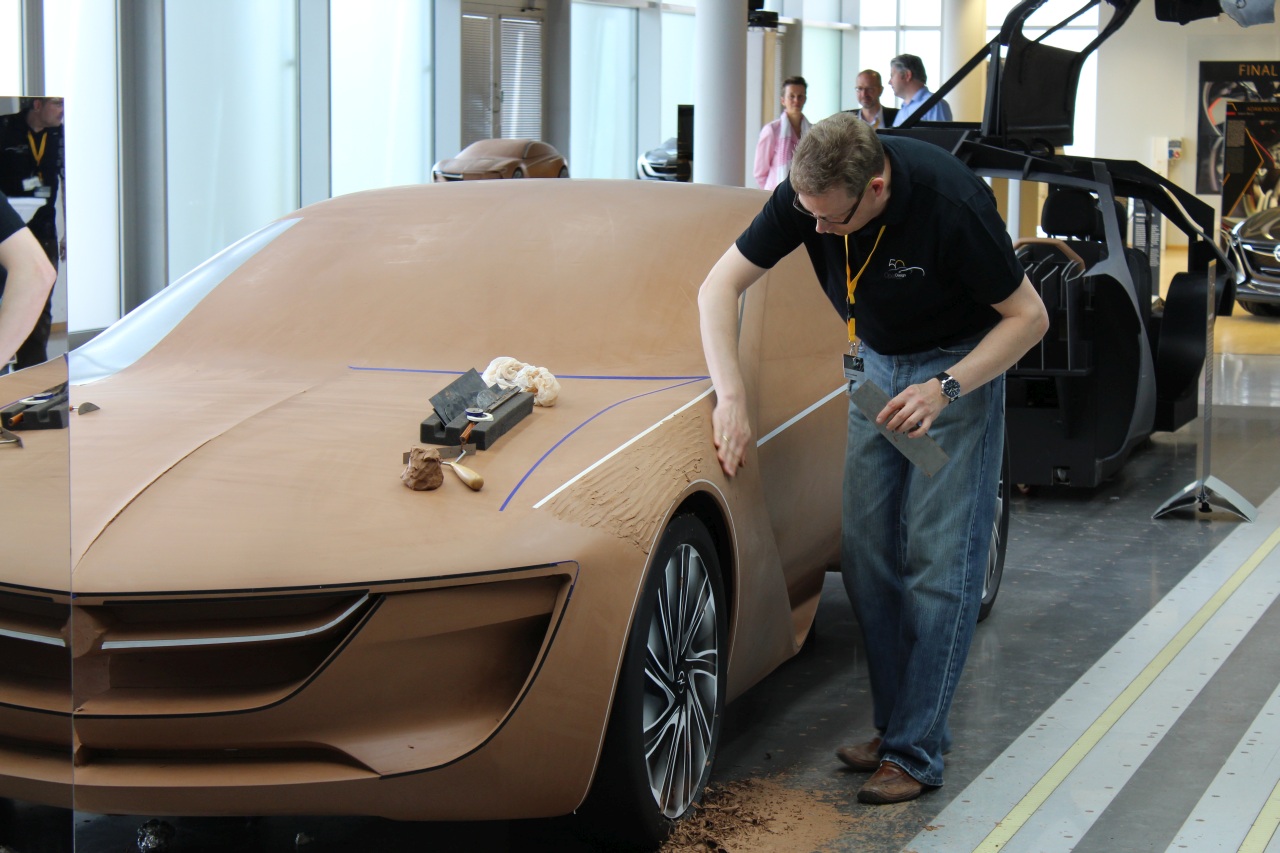
A full-size clay model at the Opel design centre, Rüsselsheim (2014). Photo by Robert Basic, CC BY-SA 2.0, via Wikimedia Commons.
This is the part that won't scale. Agents get smarter every year, but the humans looking at the boundary object are the same ones who painted Lascaux. When it comes to agreeing on a goal, I don't see a difference in nature between today & 20,000 years ago: we still "paint the objective".
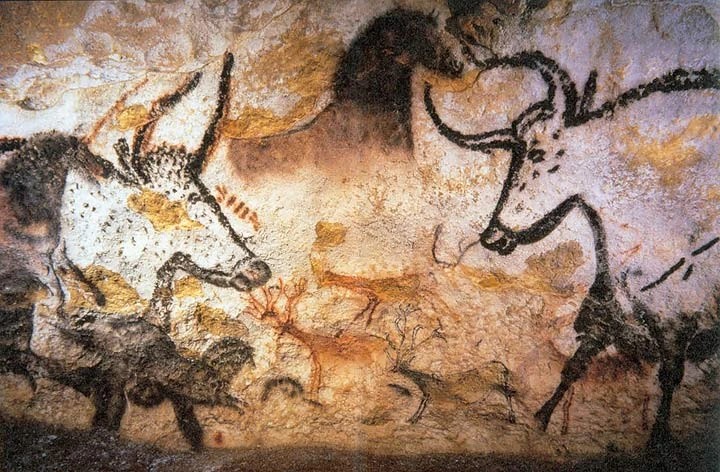
Hall of the Bulls, Lascaux, about 20,000 years ago: painting the objective, the original boundary object. Photo by Prof saxx, CC BY-SA 3.0, via Wikimedia Commons.
2. A convergence view
Not "what are agents doing" but "how far are we from done". Are the acceptance checks passing / are open questions going down / is work being redone / is the agents' estimate of what's left settling or still swinging? A team that is not making progress while burning resources should be obvious at a glance.
By open questions, I don't mean questions about the "how" (that's the agents' job), only the ones where the work conflicts with the strategic intent we started from. Most of the time they should ask for context, not for a decision: "can you give me this context so I (the agent) can decide", not "should we do A, B or C". The exception is when the goal itself might have to change: then it's our call.
And it has to work both ways: sometimes new strategic ideas come from implementation ("we could drop this whole module" / "this constraint is the real problem"). Agents need a way to bubble these up to the surface, so we can decide if the goal itself should change, instead of them drifting silently or the idea getting lost in a log.
The methodology behind it can be complex (tests, metrics, tracking what each agent session changed...), but the reporting medium has to be something a human grasps in seconds, for the same Lascaux reason. We should be able to read it, print it, touch it. This lens is as important as the "goal" boundary object.
My favorite convergence view is from 1869, and it shows a plan that didn't converge at all. Charles Minard, a French civil engineer, drew Napoleon's 1812 campaign in Russia as a single chart (below). The width of the band is the size of the army: red on the way to Moscow, black on the way back, with the temperature during the retreat underneath. 422,000 men set off, about 10,000 came back, and you see it without reading a single number. Edward Tufte called it possibly the best statistical graphic ever drawn. For me it's the bar for a convergence view: a plan meeting reality, readable at a glance.
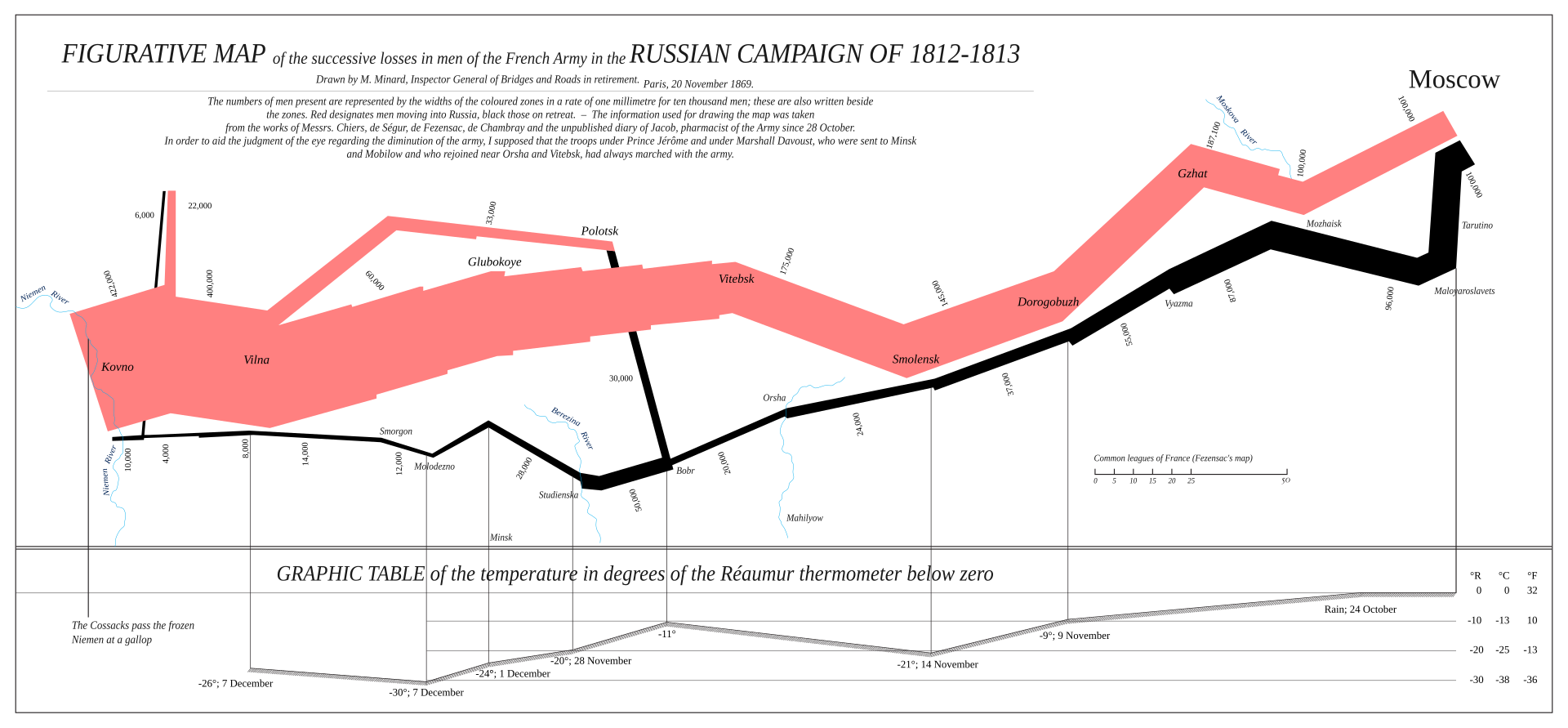
Charles Minard, figurative map of the losses of the French army in the Russian campaign, 1812-1813 (1869). English redrawing by Iñigo López Vázquez, CC BY-SA 4.0, via Wikimedia Commons.
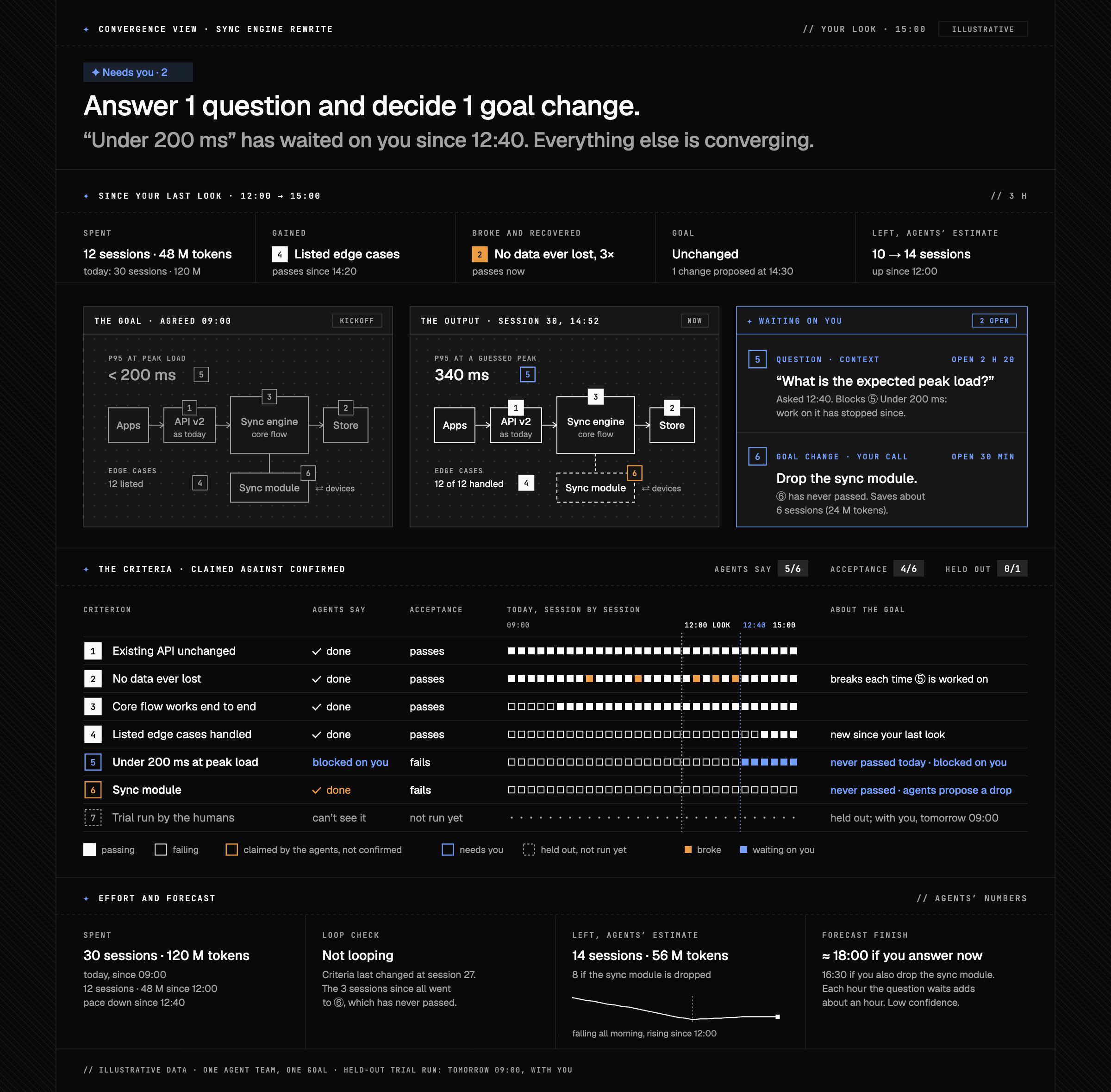
What a convergence view of one agent team could look like at the humans' second look of the day, at 15:00, six hours after kickoff (a sketch with illustrative data; the goal and output diagrams stand in for the real prototype).
3. Acceptance
Even if it comes last here, acceptance should actually come before any implementation starts: written in parallel with the description of the goal (1), not once the work is done. Delegating the "how" to agents only works if the goal comes with its acceptance criteria.
A great example of acceptance written first is 300 years old. In 1714 the British Parliament had a very clear intent: find a way for ships to know their longitude at sea. It set the acceptance criteria upfront: £20,000 for a method accurate to half a degree, proven on a voyage to the West Indies (smaller prizes for 40 minutes or one degree). And it left the "how" completely open. Astronomers, mathematicians & plenty of cranks all tried in parallel, and the solution came from a self-taught clockmaker, John Harrison, with a sea watch nobody saw coming: on its trial voyage, H4 lost about 5 seconds in 81 days.
Side note: the judges (swayed by astronomers backing a rival method) then dragged their feet for years and never formally gave him the prize, a good reminder that the acceptance has to be agreed upfront & honored.
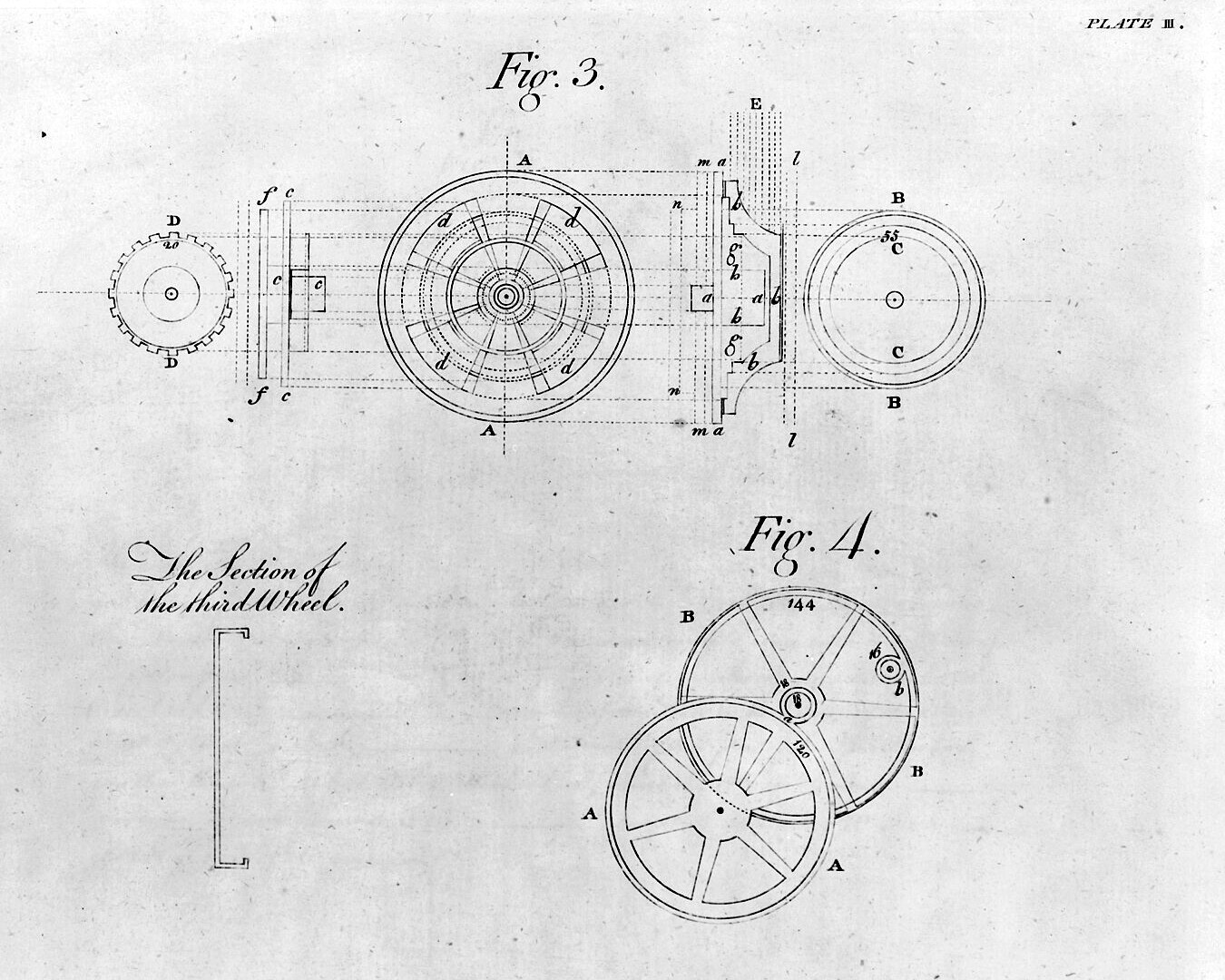
Plate III of the engravings of John Harrison's H4, published by order of the Commissioners of Longitude (1767). Public domain, Library of Congress.
For complex systems, the goal alone is not enough. Looking at the end product and saying "yes, it looks exactly like what we wanted" only checks what's visible: edge cases, failure modes, performance over time, safety... don't show up in the picture. That's why in the V-cycle (the V-shaped process used to engineer cars & planes: specs going down one side, tests coming back up the other) the specification & the acceptance tests are two different things: one says what to build, the other how we'll decide it's right. If the acceptance is written after, whatever gets built tends to quietly become the reference.
With agents it matters even more, because looking plausible is something they're very good at. So the acceptance should not be written by the agents doing the work. They can check most of it as they go, but part of it should stay out of their reach, like a trial at sea. That's what makes it safe to let go of the "how", and it's what turns "converging" into something you can actually measure.
What military doctrine can teach us
I think it's quite natural to look at "inhuman management strategies" (war is inhuman, agents are non-human) that have been deployed "at scale"... It seems that armies have been working on this same question for a long time, and I found some interesting concepts. Moltke's famous line, usually quoted as "no plan survives contact with the enemy", led to mission command: you share the goal, the end state & the limits, and let people on the ground decide how.
De Gaulle thought along similar lines: centralizing on strategy, yet leaving room for his field commanders on tactics. In 1925 he published "Doctrine a priori ou doctrine des circonstances ?", which later became the "De la doctrine" chapter of Le Fil de l'épée (1932). His point: war is contingent by nature, so principles are only worth something if they're adapted to the circumstances. He warned French military thinking against its taste for a priori, absolute & dogmatic systems. Instead, he asked for a sense of the concrete & of reality, and for leaders with character, who take responsibility & judge for themselves when reality doesn't match the plan.
But he also saw the other side. In La Discorde chez l'ennemi (1924), he showed how too much autonomy among some German generals (Kluck at the Marne in 1914, under a different Moltke, his nephew) ended in disobedience & contributed to breaking the whole. I think autonomy without a shared intent doesn't converge. That's exactly why we need both: freedom on the "how", and a strong shared intent + a convergence view to keep everyone pointed the same way.
And as he supposedly said, "l'intendance suivra" ("logistics will follow") 😄. Minard drew how that went for Napoleon. With agents, the "how" can follow, as long as we own the goal & the acceptance, and keep watching the convergence.